Food & DrinkDesigning the Ultimate Home Kitchen? Shannon Bennett Has Some Tips

-4e28a76245.webp)
Kitchens are so often the heart of our homes. They’re where we congregate, share meals, say “smells good” when the scent of melted butter and garlic wafts through the air, and fight over how to stack the dishwasher.
For chefs, the kitchen is even more meaningful. It’s their office, the place they have the most control (or completely surrender control) and where they spend most of their time.
Shannon Bennett’s home kitchen in Belongil Beach, Byron Bay is a perfect example of this. The celebrity chef moved there after selling the Vue Restaurant Group in 2017, during his “sabbatical” from the restaurant world. Now he’s back, heading multi-venue hospitality destination The Belongil right near home.
He wanted the architecture to blend seamlessly into the Byron hinterland, while the fit-out is incredibly international. The kitchen was designed by Woods Bagot CEO (and Bennett’s mate) Nik Karalis and built by Italian kitchen design house Arclinea, while the appliances are from German brand Miele.
“I just wanted this big square bench, which I could cook off, people could sit around, talk, interact with me, and then easy access to all the appliances and all the fridges, with anything that I didn’t want you to see completely recessed and hidden with no handles,” Bennett says.
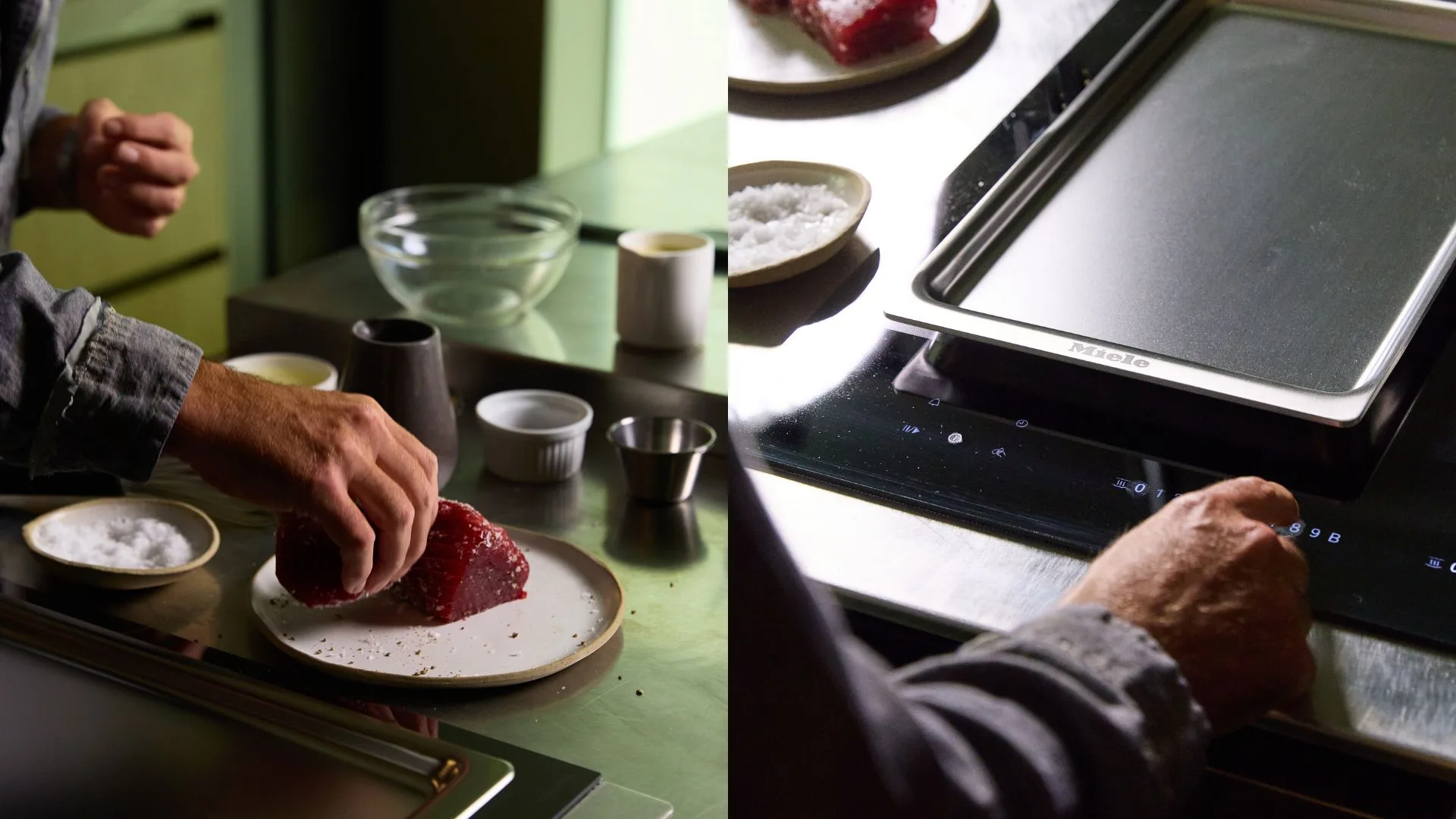
When it comes to appliances, it might be easier to list what he doesn’t have. “I wanted built-in induction, and then from there I got all Miele appliances … I’ve got a vacuum-seal drawer, which I use a lot to sous-vide. I’ve got a built-in pressure steam oven, a combi steam oven and a normal conventional Miele oven. I’ve even got an induction wok in my kitchen. It looks like an incredible piece of artwork. It’s basically a concave piece of glass recessed into the stone bench. You put any wok into it.”
The chef is admittedly the sort of perfectionist who is “never satisfied”, but ultimately his kitchen comes pretty close. These are his tips to make your home kitchen more functional, professional and design-forward.
When it comes to a renovation or a new build, it can be easy to get caught up in aesthetic decisions. But, above all else, your kitchen should be a space that works.
“Always start with appliances. Functionality first,” he says. “Then the layout and the flow. Then, from there, it’s the aesthetics.”
Bennett approached his home kitchen the same way he approached designing restaurant kitchens, planning it out depending on the flow of the cooking process. This means appliances should be a couple of steps away from each other, but far apart enough that multiple people could be using the kitchen without getting in each other’s way.
He also says induction stovetops can be used as bench surfaces when not in use, so don’t be scared to have an induction stove installed directly in the middle of your benchtop.
Only after that do you start thinking about the look of the kitchen. “The aesthetics should be aspirational. They should be something that when people see it, they say, ‘Wow, I would love that in my own home.’ That’s how I look at restaurants, and I look at my own home as my own little private restaurant in many ways.”
“When a kitchen is designed really well, it nearly cleans itself,” says Bennett. While a self-cleaning kitchen might still be a few years into the future, Bennett says you should create a space that makes cleaning as easy as possible.
“Position your dishwashers beautifully,” says Bennett. “I like to position the dishwashers at waist height, not at ground height, so you basically just pull down the dishwasher door and put it straight in. You don’t have to bend down.”
He also likes to have multiple sinks – two at minimum. “Two separate wet areas: one for where you make drinks and then another sink where you’ve got dishes.”
Beyond dishwashers, Bennett says ovens and cupboards should all be above waist height, so you don’t have to bend down.
With chic appliance design, they don’t have to be hidden away below benchtops. And he’s right: it’s much easier than bending down or squatting to open doors or put things away.
If it was up to Bennett, almost nothing would be below bench height. He’ll make an exception for large pots and deep storage items that you don’t have to access every day.
This article is produced by Broadsheet in partnership with Miele.

Produced by Broadsheet in partnership with Miele.
Learn more about partner content on Broadsheet.
About the author
Lucy Bell Bird is Broadsheet’s national assistant editor.


More from Broadsheet
Videos
More Guides
Recipes







-6e9e4d4cb1.webp)
-c121bced4e.webp)