Food & DrinkRecipe: You Can Make This Sauerkraut Using Any Old Fruit and Veg


Words by Che-marie Trigg · Updated on 03 Apr 2025 · Published on 31 Mar 2025


Flicking through The Pocket Pickler by Alex Elliott-Howery, the co-founder of Sydney’s Cornersmith , you quickly come to realise you can pickle and ferment – or even make chutney, salsa or sambal – out of almost anything. If you’re saddled with too much pineapple, say, you could turn it into a Sri Lankan-inspired pineapple and chilli sambal. Or, if you have a glut of tomatoes, you can make them into a chutney to pile onto sandwiches and sausage rolls in the months ahead.
The book is a rollcall of 80 recipes, all taken from Elliott-Howery’s four previously published cookbooks, including Use It All and Cornersmith. Like Cornersmith – which started as a cafe but is now a cooking school – it aims to divert perfectly edible food from landfill and teach home cooks that fermenting and pickling is more accessible than it may seem.
This versatile sauerkraut recipe is by Jaimee Edwards, Cornersmith’s head fermenter and teacher. “It’s a very flexible one in which you can use up vegetable stems and leaves, or those bits lurking in the back of the fridge,” writes Elliott-Howery. “All together you’ll need 2 kilograms of produce, including 500 grams [of] fruit and veggie ‘scraps’.”
The flexibility of this sauerkraut means you can flavour whatever produce you’re using with whatever whole spices or herbs you like. “Caraway seeds are a classic with cabbage, apple and onion; black peppercorns go well with fennel and beetroot; and kale and dill are really delicious together,” writes Elliott-Howery.
You can quarter or halve the recipe if you want to make fewer jars. It will last up to six months in the fridge.
About the author

Makes 3–4 jars
Preparation time: 40 minutes, plus 2 days– 2 weeks fermenting time
1.5kg white cabbage
500g assorted leftover fruit and vegetable bits, such as onions, apples, pears, chokos, kohlrabi, chopped parsley, dill, beetroot, fennel, kale and celery
1½ tbsp salt
1 tbsp whole spices of your choice, such as juniper berries, caraway seeds, bay leaves and black or white peppercorns
Cut the cabbage into manageable pieces and shred any smaller portions of cabbage into thin strips. Put it in a non-reactive bowl large enough to hold all your produce.
If you are using apples or pears, cut them into thin strips and set aside. Cut your other vegetables and greens to about the same size as your cabbage, then add them to the bowl.
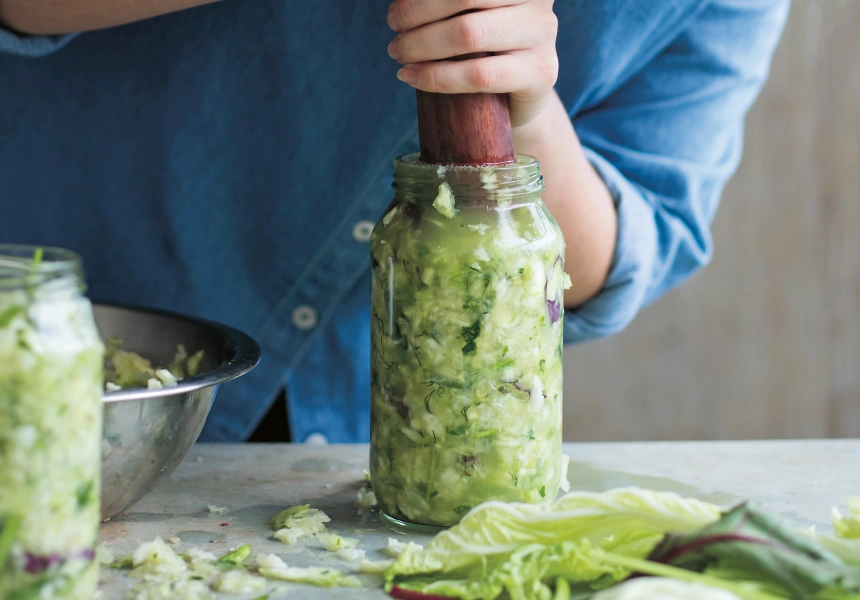
Sprinkle the salt on the cabbage mixture and mix thoroughly with your hands. Using a pestle, or a rolling pin without a handle – or even the top side of a meat mallet – pound your produce until a lot of the water is released. You should be able to grab a fist full of the mixture, give it a squeeze, and see brine running freely. At this stage your sauerkraut is ready to put into jars. If you are using apples or pears, mix them through now. Taste the cabbage, adding salt if needed.
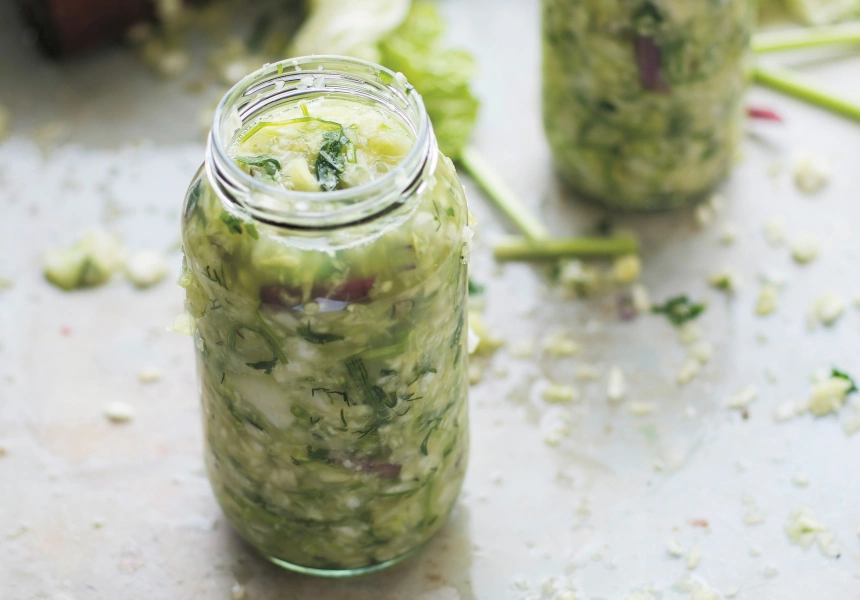
Put the sauerkraut into clean jars and pack down very tightly, to about 2cm from the rim of the jars, allowing about 1cm of the brine from your produce to cover the top of the mixture. This is very important to prevent spoilage.
Seal your jars and place them out of direct sunlight. In temperate weather, leave to ferment for at least 4 days; in summer, it is advisable to check on your sauerkraut after 2 days, as fermentation will happen much more quickly.
Open your jar every few days to “burp” your ferment – this will release the built-up carbon dioxide and prevent brine spilling out of the jar. Just be sure to press down your sauerkraut afterwards, so that the brine is covering the top by at least 1cm.
You may leave your sauerkraut to ferment for 2 weeks, checking every few days to see and taste how it is developing. Once you are happy with your sauerkraut, refrigerate for up to 6 months.
Images and text from Pocket Pickler by Alex Elliott-Howery, photography by Alan Benson. Murdoch Books RRP $29.99.

More from Broadsheet
Videos
More Guides
Recipes




-6e9e4d4cb1.webp)
-c121bced4e.webp)