Ben Mazey’s Playful Works Freeze Motion in Clay
-8815505aa5.webp)
-499b21c95a.webp)
-84b47b0dc3.webp)
Words by Gitika Garg · Updated on 20 Aug 2026 · Published on 31 Jul 2026
Ben Mazey spent seven years in Paris as design director at global fashion house Kenzo before returning to Australia, where ceramics became an “accidental Covid pivot”. A few short years later, he’s become one of the country’s most sought-after contemporary artists.
When Broadsheet meets the New Zealand-born artist at his two-storey warehouse studio in Melbourne’s Coburg North, he speaks with quiet earnestness, punctuating conversations with perfectly timed deadpan one-liners. His dog Ted, who he adopted during a year living in Shanghai, never leaves his side. “I feel like I’ve become a parody of myself,” Mazey says. “I’m that guy who’s got a street dog and makes it their whole personality on social media.”
His oversized hoodie reads “Optimistic realism” in wonky embroidery. The word “optimism” is also tattooed across his knuckles. It’s a fitting description of both his work and outlook.
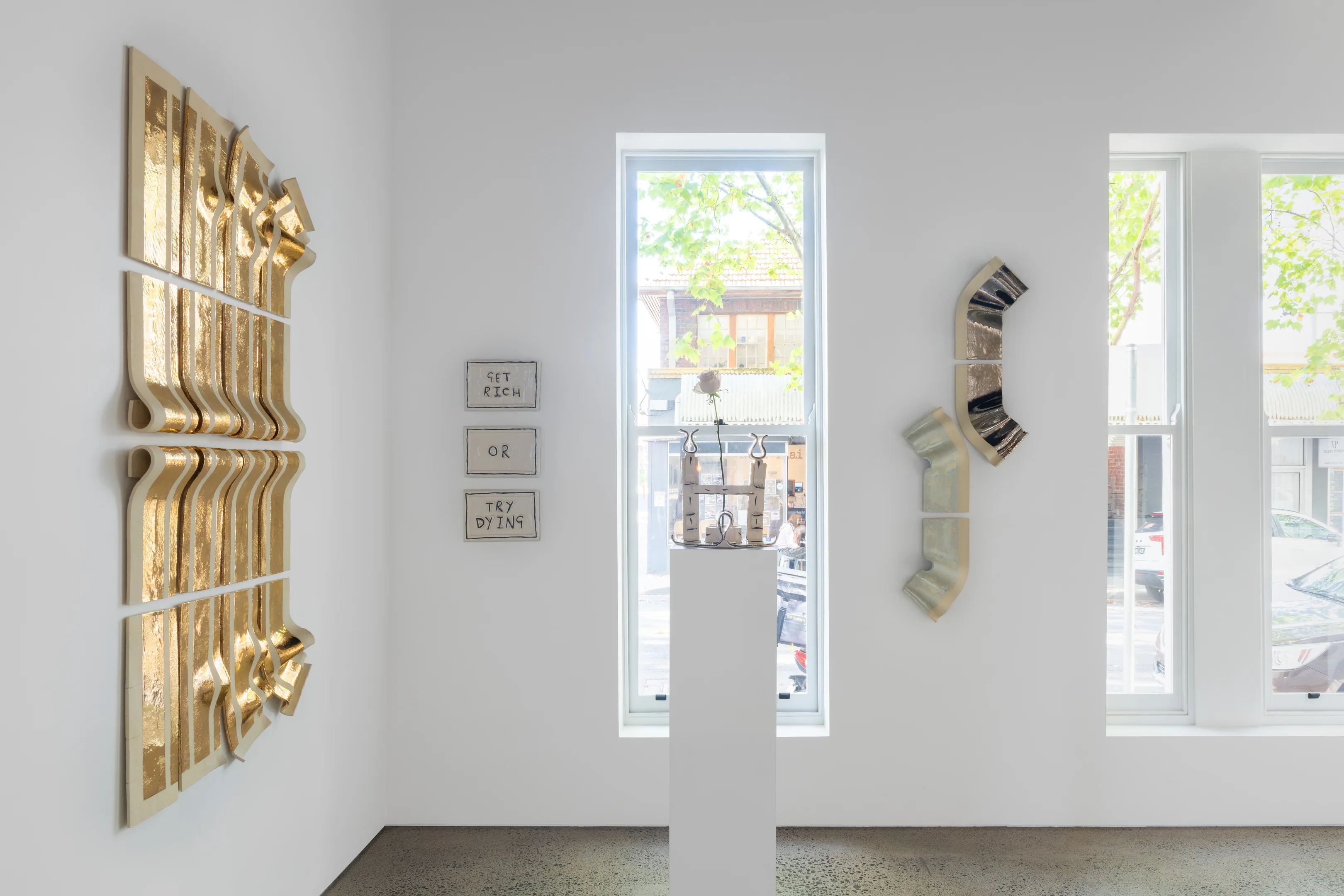
It’s surprising, then, that his latest solo exhibition, If You Can’t See This You Might Be Dead or Just Not There, explored themes of death. “It’s kind of tongue-in-cheek,” he explains.
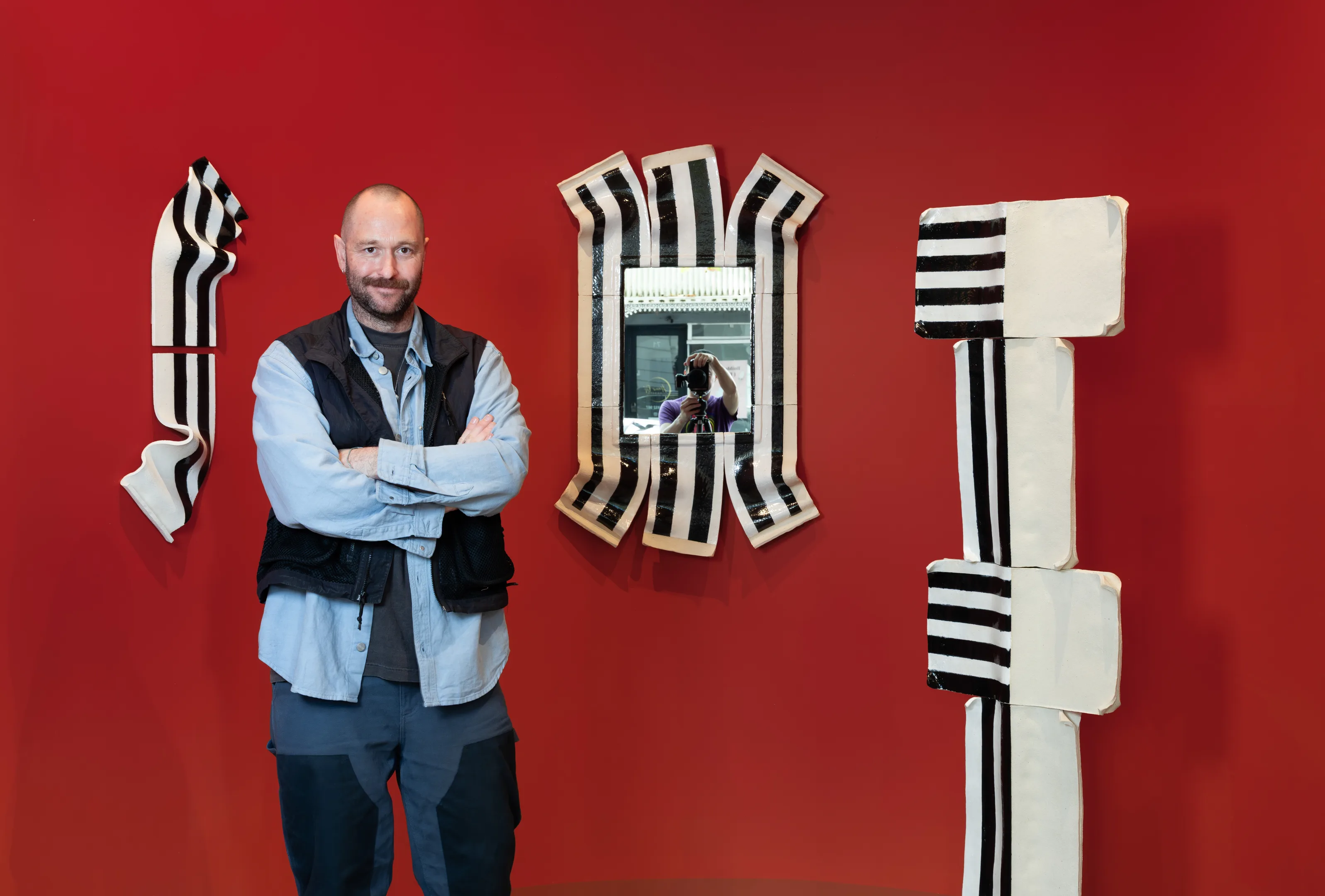
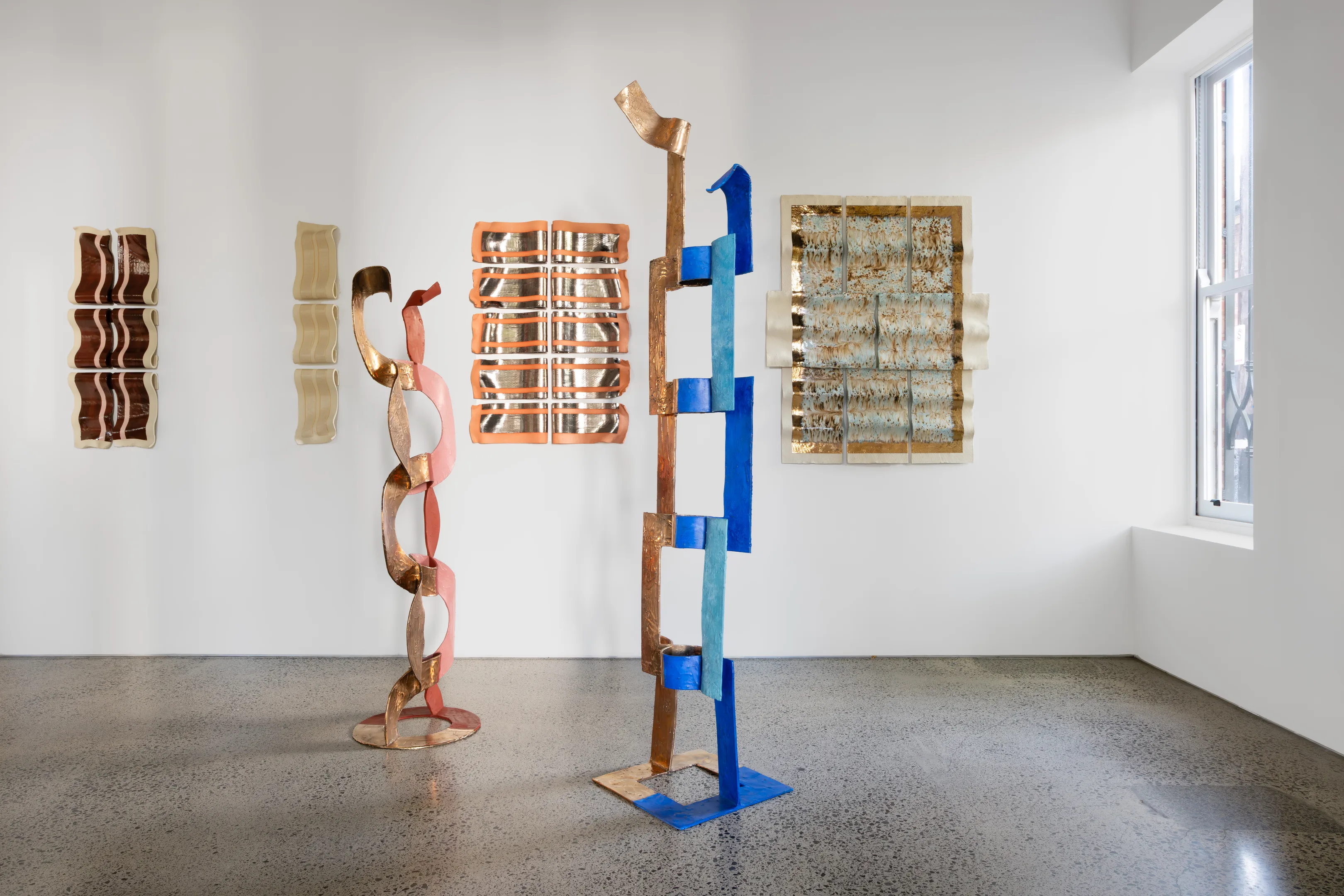
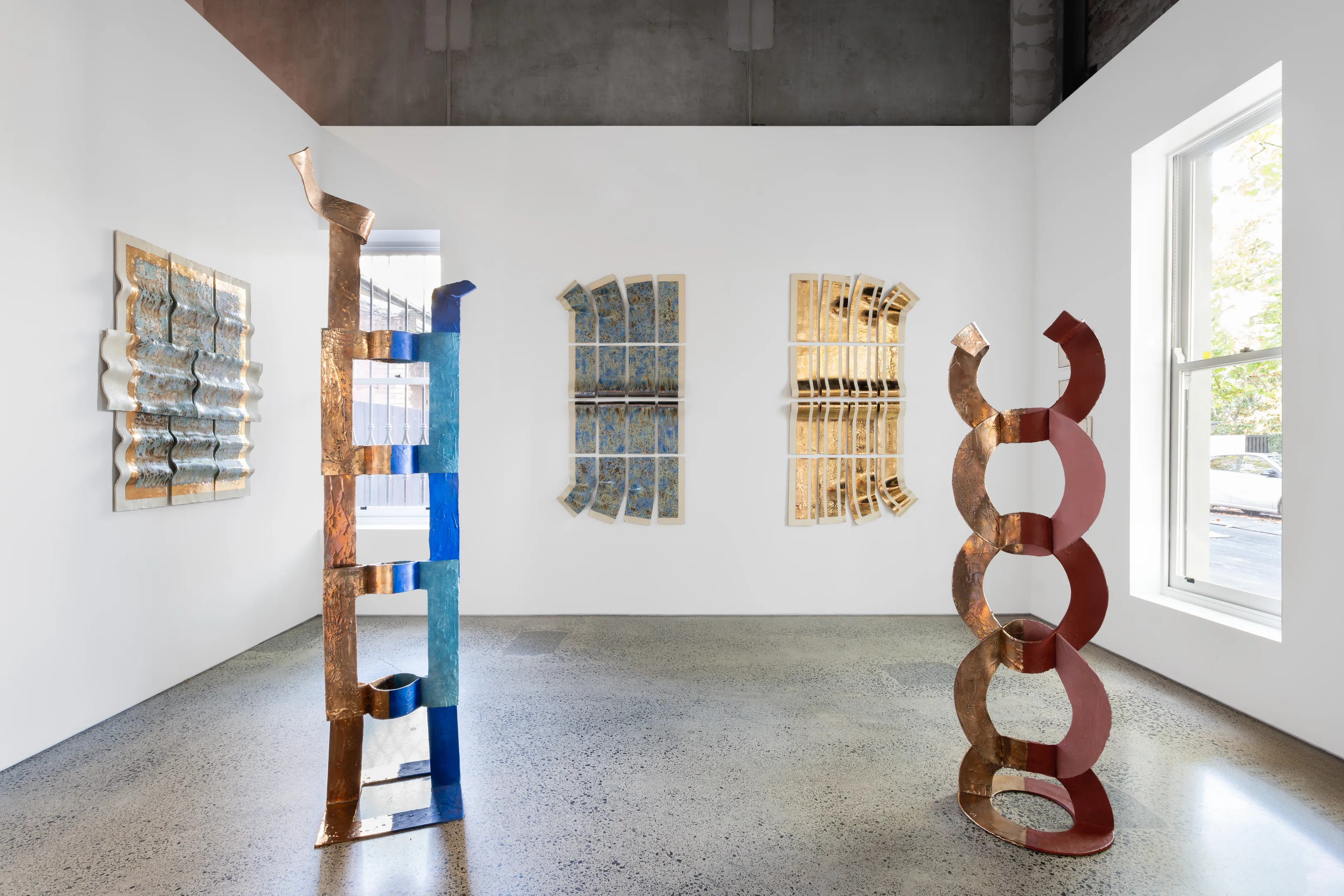
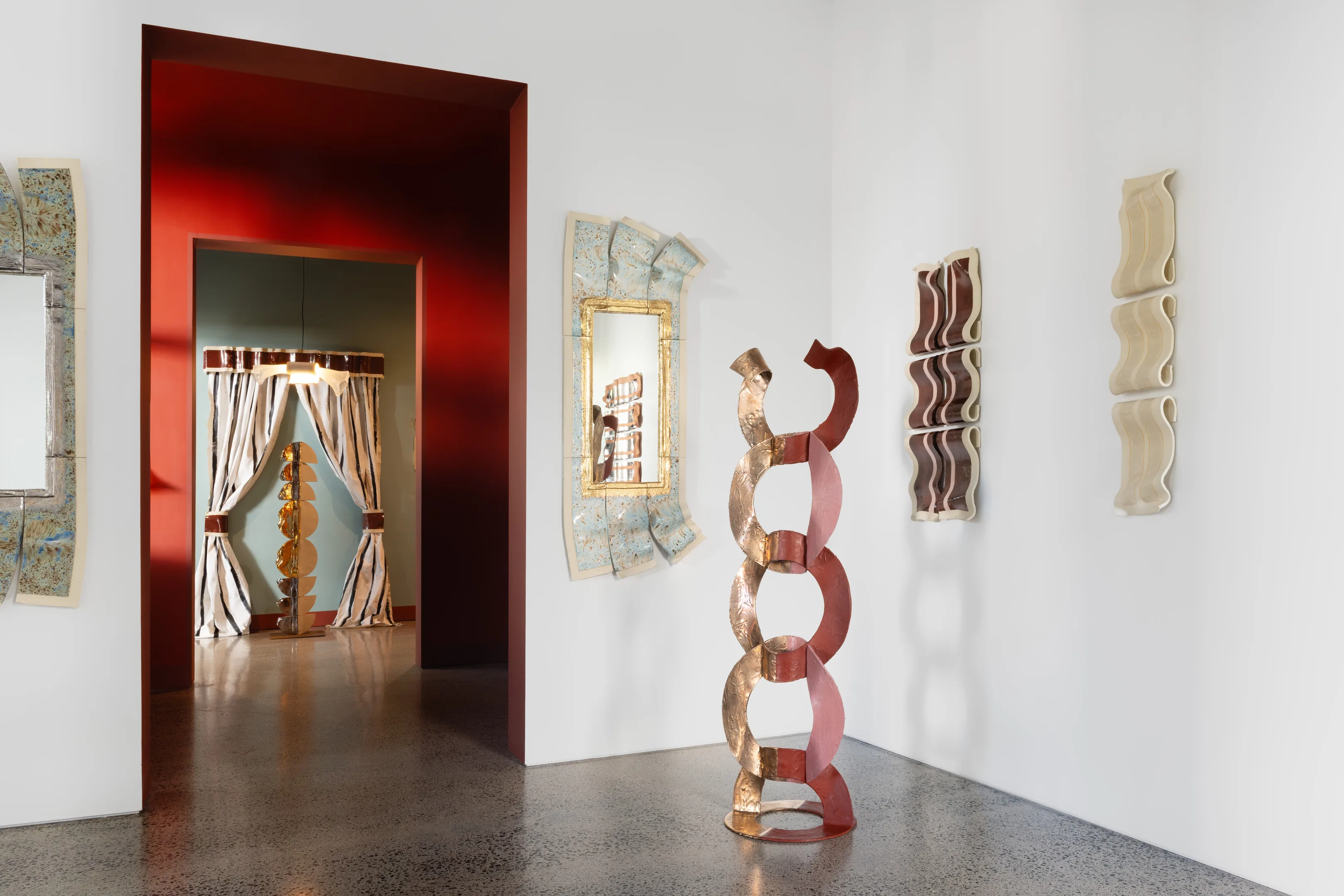
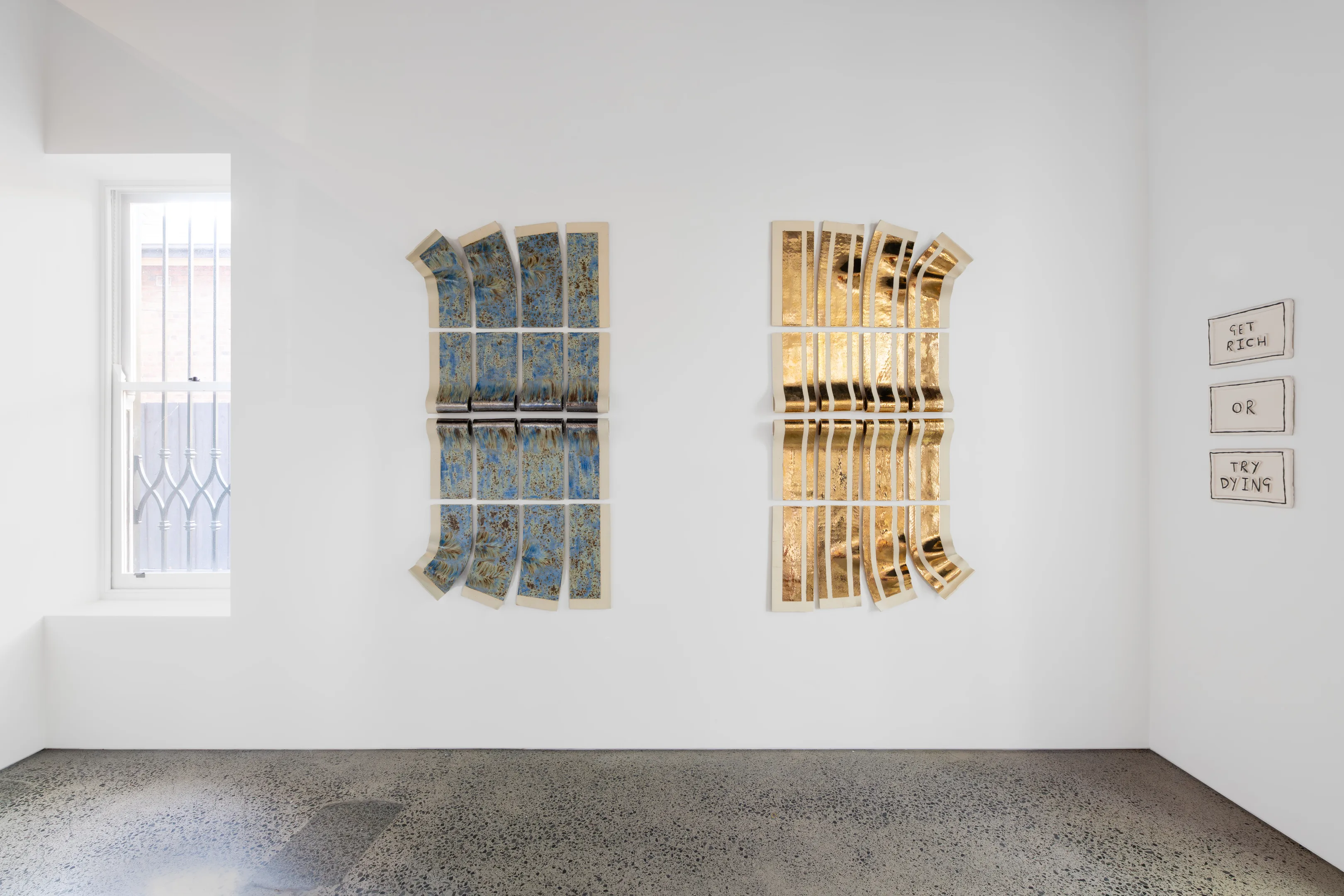
The show transformed wonky vases, fluted mirrors, ceramic tiles and old-fashioned curtains into playful, cartoon-like forms in his signature wavy aesthetic. It’s a simple but effective approach. “Not to dumb my work down but I’m all for democratic appeal,” he says.
Across all of his work, Mazey captures small, familiar movements: a breeze rippling over water, a carpet folding over itself, a flag blowing in the wind. “There’s a real DIY simplicity to it.”
We visit Mazey in his Melbourne studio after the show to talk making art, his distinctive approach to glazing and the album he’s listened to every day for the past 21 years.
How did you move from fashion into ceramics?
I call this my accidental Covid pivot. I didn’t set out to have this art practice, but I was one of those people who got really productive in the pandemic. When Covid hit, I’d been living in Shanghai and I was back [in Australia] on holiday for Chinese New Year and essentially just didn’t go back. I took a lease on an empty apartment and just bought a bunch of supplies and was like, “I’m just going to pretend I’m on sort of a self-directed residency,” and started making stuff. And it escalated from there.
What do you remember about those early days of experimenting with clay?
Technically, what I do is very simple. I remember this really delicious period where I would literally Youtube how to do two things and then set myself little challenges like, “Maybe I could make a lamp,” or “Maybe I could do a mobile,” or “Maybe I could join two things together.”
What I did in those early days, which was roll out this stuff and add a bit of a fold here, is kind of still how I operate.
Your work has such a distinctive curved, wavy language. How did you arrive at that aesthetic?
I really like repetition and this idea of a flag blowing in the wind and if you froze it, it was different depending on when you froze it. [When I was a kid,] we had this VHS of the Seoul Olympics and I was really besotted with watching the rhythmic gymnastics. They had the ribbon, and if you’d press pause on the VHS, depending on where you paused it, the ribbon [was frozen in different shapes]. So much of my work starts from this 20-by-50 rectangle and it’s frozen like that. I’ll basically do all these different iterations of different forms, then arrange them in a certain way and then it just becomes like different iterations of the same thing. I’m making kind of a collage of these frozen ribbons or flags. My work’s very simple and I’m really okay with that.
Are there any elements of the fashion world that shape your art practice today?
I definitely think there’s something in my use of colour and proportion that is quite linked to what I would gravitate towards in fashion and a lot of the work I did. I didn’t really clock this until someone [pointed out that] so much of what I do with the clay does end up feeling fabric-like – it’s like these frozen drapes.
Someone like Martin Margiela, who I absolutely froth [over] – what he did was so revolutionary, but there was like a real DIY simplicity to it that was familiar. I definitely aspire to have that kind of naive simplicity that was in so much of his work.
Where do you find inspiration?
I think the easiest way I find to articulate it is, there’s this Jung quote (I’m quite a Jung fan), and he says that life begins probably in your forties; everything until then is just research. I want to preface this by saying there are people that are 24 doing amazing things, but I started my practice as I was turning 40, after a 20-year period of research, and that really resonates with me. I think it’s mining this internal catalogue of reference points.
How does a new piece usually begin? Can you walk us through your process from idea to finished object?
I think there are two main components. So you’ve got the testing of shapes where it’s like, “What can I do with a 20-by-50 rectangle?” There are different ways that this 20-by-50 rectangle can be manipulated. And then once I’ve got a few of them, I just lay them out. It’s almost like Lego bricks. I see where they get to a sweet spot and it feels like something I’m emotionally responding to.
Then the secondary thing is the glaze and the materiality. That is just an awful lot of testing glazes, mixing glazes that shouldn’t be mixed and layering them. There’s simplicity to it – simple things arranged or rearranged. Once they group together, I’m like, “Oh, there we are,” and it becomes more than the sum of its parts.
Tell us about your kiln.
Grayson Perry says something like apparently all ceramicists fetishise the kiln, which I feel like I don’t do, but what I will say is, you know how if you use AI, you can get good at prompting it? I feel like I can get good at prompting the kiln, but then you’re still at the mercy of this machine.
Tell us about the new body of work which just showed at C Gallery.
The title of the show [was] If You Can’t See This You Might Be Dead or Just Not There. I think about death a lot and there’s this whole nihilism within my worldview. It’s kind of tongue-in-cheek as well because the way I present, the way my work presents, you’d be like, “As if that guy shows about death, he’s got ‘optimism’ tattooed across his knuckles.” Bringing this idea that we’re going to die to the forefront of my mind – I find it quite liberating.
There’s terracotta for the first time and it’s got a platinum lustre over it. Terracotta is quite a ubiquitous ceramic. Layering over the platinum is almost in a Christo way where he would layer the drape around something. How it reacts when it’s over a form is really special.
What’s on the stereo when you’re in the studio?
I listen to a lot of Adele. There’s a band called The Postal Service, and they released one album called Give Up in 2003 – I’ve listened to that probably every day for 21 years now.
About the author
Gitika Garg is Broadsheet’s assistant editor – art, design and style.
MORE FROM BROADSHEET